
Thinking locally, thinking globally

I went to a workshop day on the materiality of the far right a couple of weeks ago and in discussing our various projects, the topic of the importance of foreign-language resources was briefly touched upon.

As someone whose own scholarship can be broadly located in Global Language-based Area Studies–my PhD pathway required an element of foreign-language research, for example–that strikes me as a given. But you know how it is, you’re looking for something, and it appears that not many people have written about said thing, and that gets you thinking that perhaps your idea is a bit more novel than you initially thought as seemingly no-one else on the planet has thought or written about it, and so on and so forth. More than anything, it exposes our overreliance on English as a lingua franca when it comes to academic scholarship, particularly if you live and work in a predominantly English-speaking country.

In some respects, that is not unexpected, particularly as–in the UK at least–the teaching of foreign languages in secondary schools have been on a disastrous decline for a long time, with particular implications for pupils from less affluent socio-economic backgrounds in the long run. I for one could not have gone on my Auslandsjahr to Regensburg without support from the ERASMUS scheme, now sadly defunct in the UK following Brexit. Subsequently, many universities in the UK are facing cuts to their MFL departments, if they haven’t been ditched altogether by now. With all of this in mind, you might even get the impression that accessing resources in their original language doesn’t matter at all, especially if your own university treats its language learners so poorly.

When it comes to studying the global resurgence of the far right, an understanding of the socio-political and cultural contexts from which its various facets have emerged is vital. That is a truism that bears repeating as, in some cases, it will involve a consideration of language on two fronts. The first concerns research participants and the language they use to form understandings about their activism and the life experiences which have led to their far-right support. The second concerns academics, researchers, and journalists who have followed and written about a particular group or party in a given language/context. These considerations can be both practical and theoretical in nature.
In the methodology chapter of my book, I talk about women’s use of certain words, for example, using Klimahysterie to describe climate change. That tells me a couple of important things right off the bat. Firstly, that person appears to engage in conspiratorial thinking e.g., that climate change is a hoax or that the global response to it is over the top, or even hysterical, as the term implies. Secondly, given that the AfD has engaged in climate change denial, including platforming prominent German climate change deniers such as Naomi Seibt, I get a sense of where they stand on it politically. There is something to be said about cultural competence, e.g., the idea that while non-native language speakers may ‘succeed’ in talking with research participants in their own language, that does not necessarily mean they understand them (slang, loaded words, metaphors, etc.). Coming in as an ‘outsider’ has its own set of challenges, but I found that there is a process of give and take when it came to building trust and rapport with the women I spoke with. The majority of the women I interviewed could speak English to a passable degree but they mostly chose to speak in German so that they could sufficiently get their ideas across; sometimes translating something into English makes it lose its implicit meaning in German. Additionally, I’ve written elsewhere that there is a tension between the accurate reporting of women’s accounts and their broader empirical claims and this comes back to a central issue of power: who gets to say what, to whom, and to what end? It’s our job to critically engage with these broader empirical claims though this does not necessarily mean that we should be ‘fact checking’ women’s self-reports about their childhood or personal experiences.

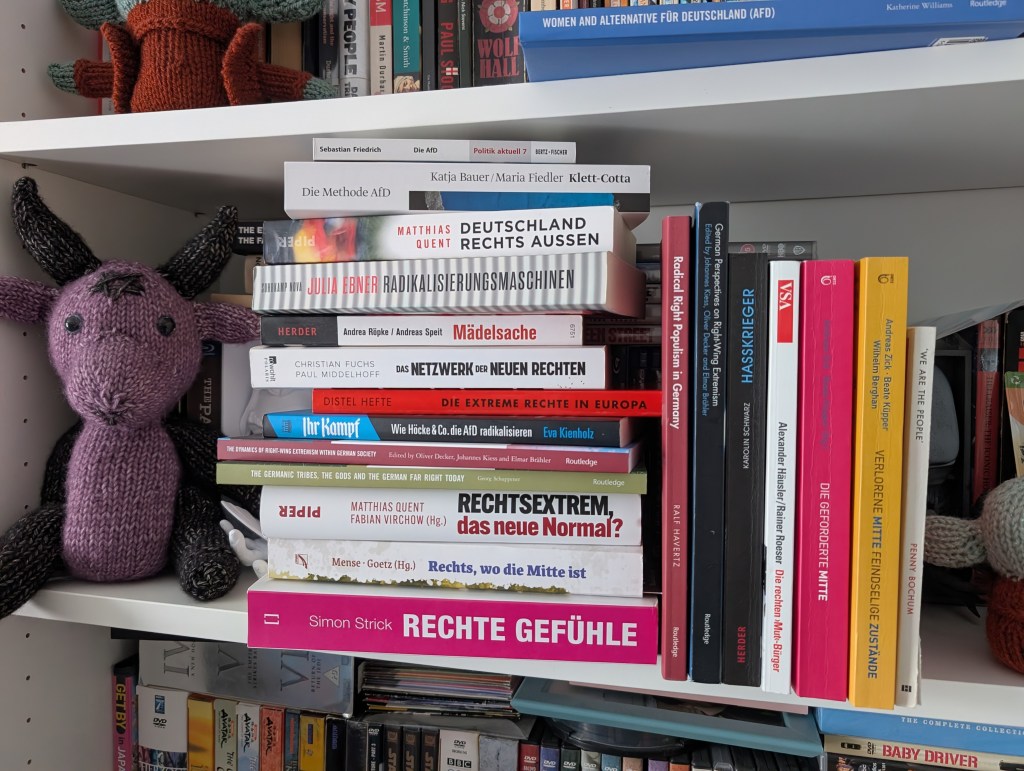
Alongside this empirical work, I utilised many German-language resources which have offered an deeper perspective on the rise (and seemingly unabated rise) of the AfD. This has been invaluable in terms of commentary on local AfD figures, the success of the AfD across the 16 German states, the legacies of reunification and how these intersect with AfD activism in the former GDR states, empirical studies measuring broader social attitudes (e.g., the Mitte Studie), the links between the AfD and local and national far-right organisations/groups, and on-the-ground federal and state election analysis. This has also involved reading the semi-autobiographical monographs of various AfD figures of past and present, e.g., Alice Weidel, Bernd Lucke, and Björn Höcke, as well as party materials. Taking the interview accounts and German-language sources together, then, I was able to ‘thicken’ my analysis and really get into the specificities of what women, the AfD, and German academic and media commentators were saying about a given topic at a particular moment in time.

As I reflect in the book, learning any language is an imperfect process, but an understanding of both language and culture is essential if we’re to traverse the rocky epistemological terrain of why people support the far right.
The numbers game

In the introduction to my book, I make the argument that the AfD’s emergence onto the political stage in 2013 is not entirely unprecedented; the German far right has in fact existed in one form or another since the end of WW2. However, the right-wing extremist political parties, e.g., the NPD (now Die Heimat) or Die Republikaner, rarely met the 5% vote threshold required by Germany’s system of proportional representation to make an electoral impact. Germany is also no stranger to right-wing extremism in the post-WW2 era, most aptly demonstrated by the case of Nationalist Socialist Underground (NSU), to give but one prominent example. The AfD’s electoral successes at both a state and federal level to date speaks to the broader global mainstreaming of the far right but certainly does not exist in a vacuum, despite breaking an existential cordon sanitaire when it comes to open support for the far right in the German context.

The numbers are nonetheless compelling; regional and federal elections have shown us that the AfD’s star is not on the wane despite its many and varied controversies and a revolving cast of party leaders which began with Bernd Lucke in 2013 and stands currently with Alice Weidel and Tino Chrupalla. Regional elections in Thuringia, Saxony, and Brandenburg in 2024 saw the AfD top the polls in Thuringia, trouncing the CDU, and coming second in Brandenburg and Saxony. Furthermore, the AfD also won 16% of the European Parliament vote of that same year, coming second to the CDU, despite allegations that AfD MEP Maximilian Krah was a double agent for the Chinese government. The 2025 federal election saw the AfD come second after Friedrich Merz’s CDU with 20.8% of the vote and 152 seats in the Bundestag. These electoral successes come despite the so-called Brandmauer, or ‘firewall against the far right.’ In theory, this means that the AfD will not be able to form coalitions with the other parties in the event that it does not secure an outright majority. 

State elections in Saxony-Anhalt on 6th September of this year saw the regional AfD fraktion led by Ulrich Siegmund win 43.8% of the votes. This is a significant development given that the AfD in Saxony-Anhalt are officially designated as right-wing extremist by the domestic German intelligence service, the Bundesamt für Verfassungsschutz. This follows the example of the AfD fraktion in Thuringia led by Björn Höcke, who, amongst other controversies, stood trial in 2024 for using a banned Nazi slogan during a campaign meeting. Despite this victory in Saxony-Anhalt, however, the AfD has not won an outright majority; commentators suggest that the left-leaning and pro-Russia Sahra Wagenknecht Alliance (BSW auf Deutsch) may fill that gap. In subsequent weeks, the AfD has ousted the CDU from the state parliament in Mecklenburg-Vorpommern, with Die Linke finishing first in Berlin, also ahead of Merz’s increasingly beleaguered CDU. 

We rely on statistics to tell us some innate ‘truths’ about the world as we perceive it; it is clear, for example, that there is an appetite for what the AfD has to offer its potential constituents, with it overrepresented in the eastern German states but finding a foothold in each of Germany’s 16 federal states since 2017. However, with each subsequent election cycle we continue to be shocked at these continued successes, and crucially, the different groups of people who appear to support them. Figures show us, for example, that when it comes to the 2017, 2021, and 2025 federal elections, 9.2%, 7.8%, and 18% of women, respectively, voted for the AfD nationally. Those are not insignificant numbers. However, despite seemingly challenging our assumptions about gender and far-right support, they tell us very little about the person behind the vote at the ballot box and the micropolitics of their everyday lives which make this support possible in the first place.

We get stuck in an infinite feedback loop of wondering where it all went wrong; what we miss from debates and commentary following these elections in Germany is a level of nuance which invites us to (attempt) to move past our own biases and confront the awkward reality that women find the AfD and its ideas appealing, empowering, and rational. Unpacking this support, however, is not an easy task. My book shows, for example, that women’s AfD support is often complex yet contradictory; they engage with cornerstone party issues (same-sex marriage, family politics, etc.) on competing fronts, e.g., the personal and the professional. On the one hand, they campaign against same-sex marriage on behalf of the party, yet on the other, privately agree that same-sex couples should have the same legal rights as their heteronormative peers. This epistemological ‘messiness’ can be hard to reconcile from a researcher’s perspective but is ultimately part and parcel of how routine politics takes place today and requires further examination.

I’m currently reading Ilko-Sascha Kowalczuk’s 2024 edition of Freiheitsschock: Eine andere Geschichte Ostdeutschlands von 1989 bis heute, and he makes the point that figures and surveys are sometimes not enough to explain a certain trend or behaviour; in Freiheitsschock he refers to state-centric analyses of the consequences of German reunification which did not move beyond its immediate economic implications (p. 15). He notices a similar response to contemporary debates surrounding social divisions in Germany and the radicalisation of different segments of the population; numbers only tell us so much when it comes to how this particular situation (i.e., the success of the AfD) came to evolve into its current state (p. 15). Given that AfD support is overrepresented in the eastern German states, questions of how and why become quickly replaced with where and when this support has developed and evolved over time, place, and space. It is with this same critical lens that we need to examine the tricky epistemological terrain of gender and far-right support in Germany and the continuing appeal of the AfD across demographics.

These are just a few thoughts. Get in touch if you’d like to discuss further or comment below.

My book!

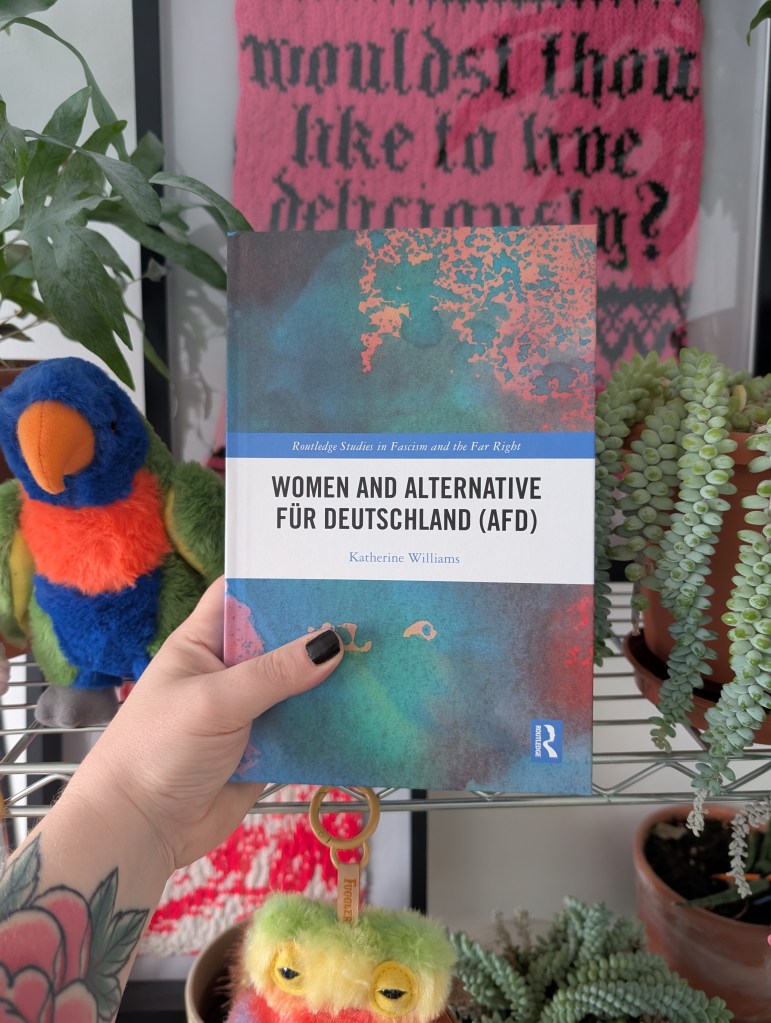
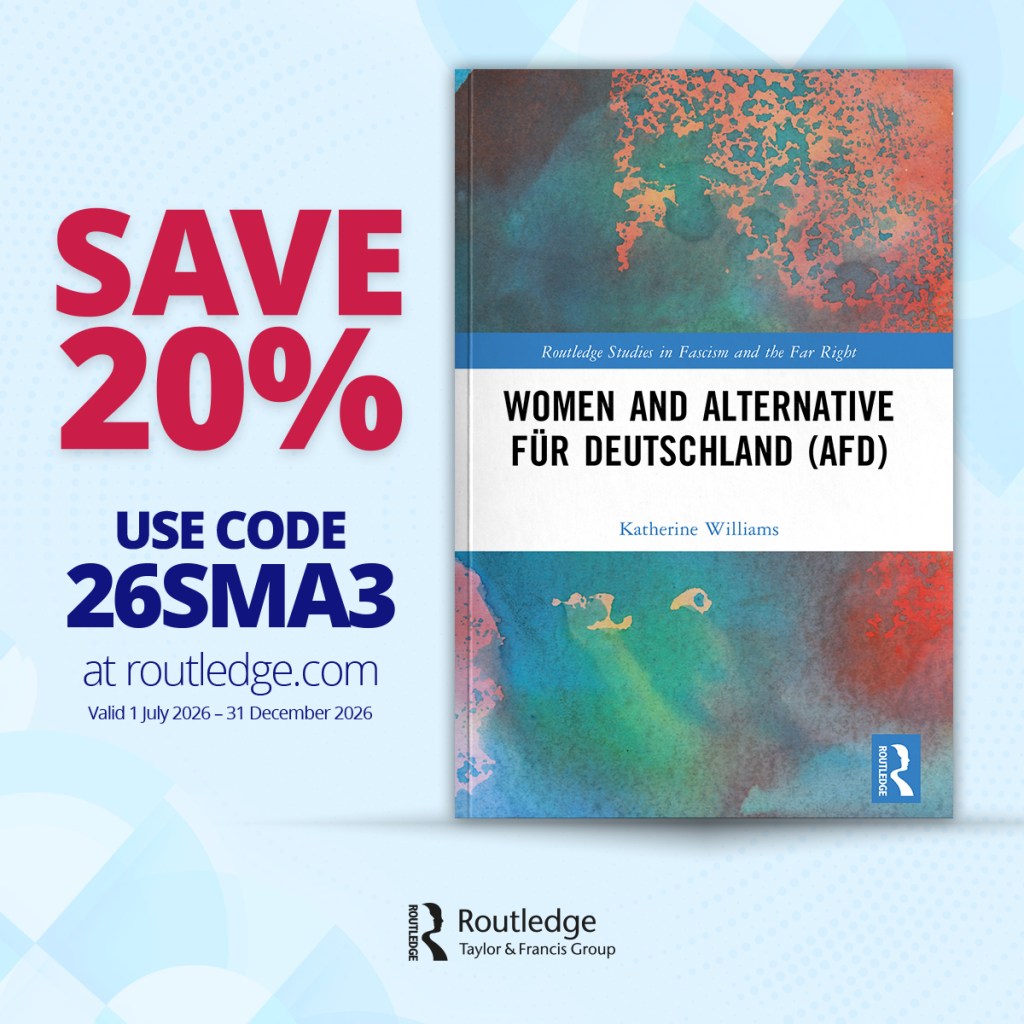
It’s been a long time in the works, but my book, Women and Alternative für Deutschland (AfD), was published on August 25th 2026 by Routledge. It’s part of the Routledge Studies in Fascism and Far Right book series and aims to shed new light on aspects of women’s support for the far right in the German context.

Based on a period of overseas fieldwork during which I conducted interviews with 8 female AfD members, my book explores how the development of women’s political subjectivity often intersects with key moments in Germany’s history and subsequent socio-political and economic transformations.

I cast a critical feminist eye over the ways in which women negotiate their understandings of their AfD support in ways which make it consonant with their own lives and experiences; women’s AfD support is exposed as complex, multi-faceted, and often very contradictory. I argue that this epistemological ‘messiness’ is often underrepresented in scholarly work on the topic of gender and far-right support as it requires us to interrogate our own biases as researchers if we want to scratch beneath the surface of dominant narratives which purport that women do not support the far right more broadly, if they are even political at all.

The core chapters of the book focus on topics such as gender and the family, Islam and immigration, extremism and agency, and the enduring legacies of reunification and the ways in which these intersect with women’s own lives and subsequent AfD support.

I am hugely grateful to the team at Routledge for giving me an opportunity to share my PhD research, as well as my family, friends, and colleagues who have supported me throughout the whole process.

My book is currently available in hardback or e-book format. If you are based at a university or college, please request a copy for your library.

I’m available to talk about my book so please just get in touch if you’d like to set something up.